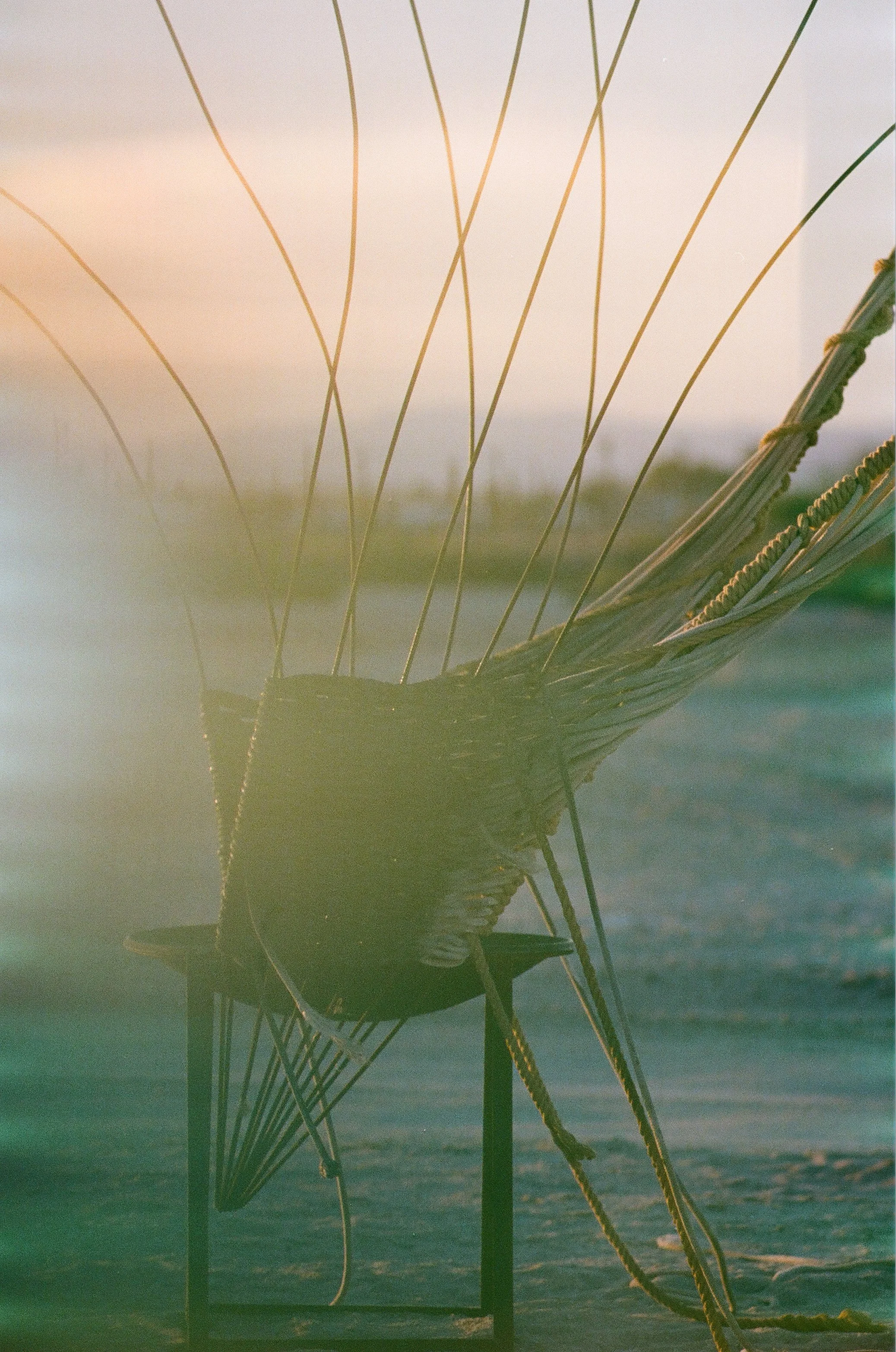
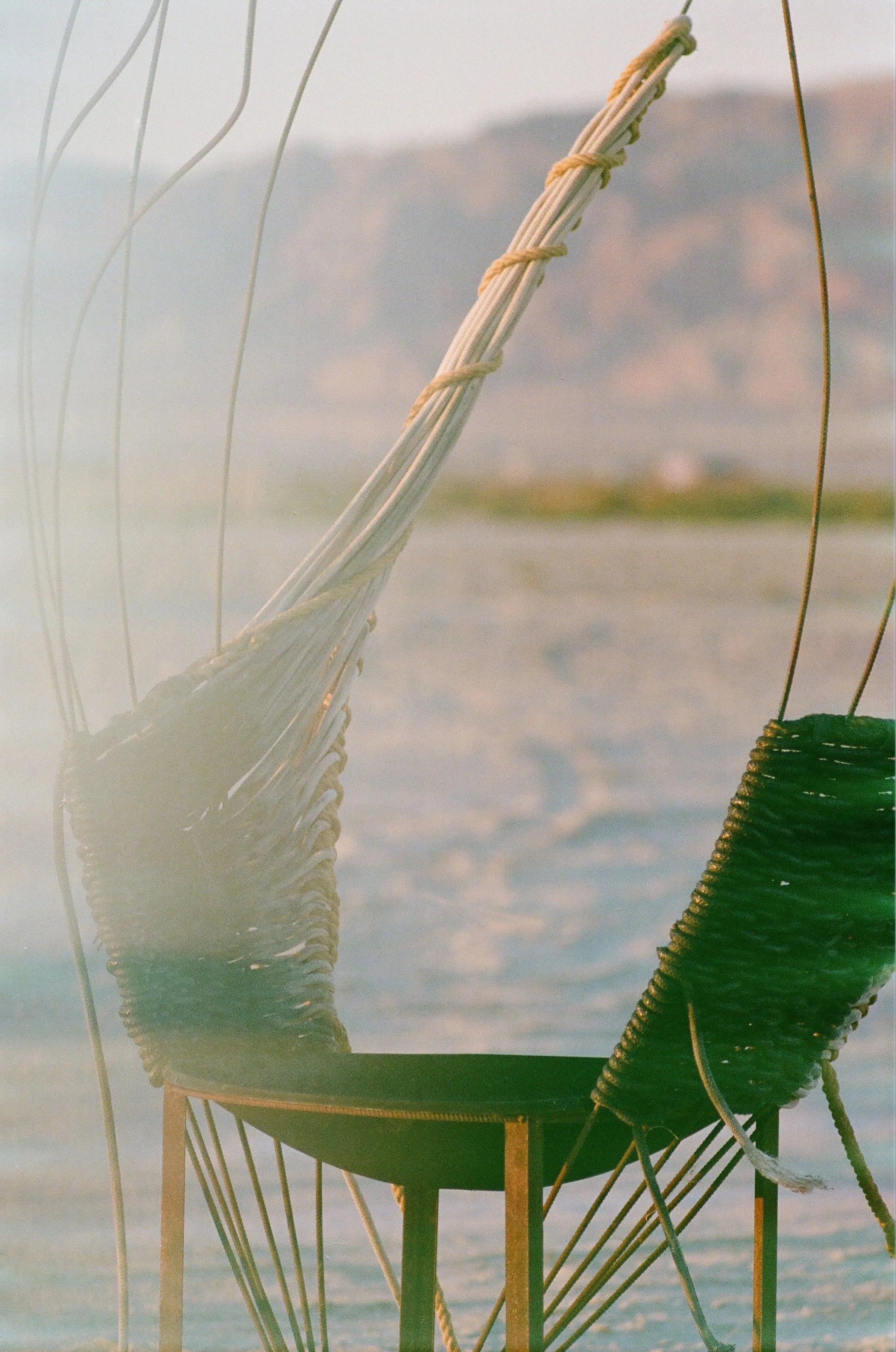
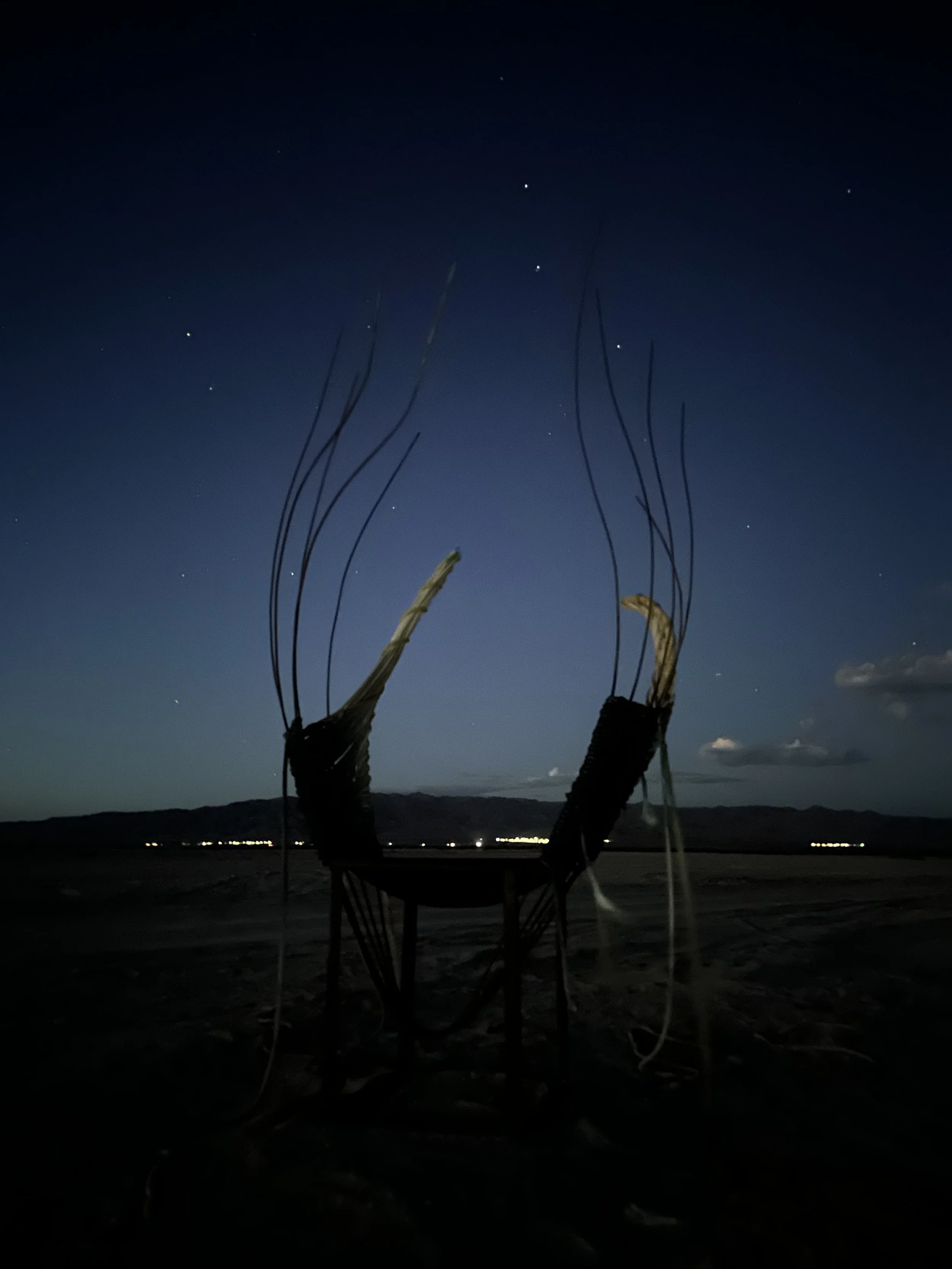
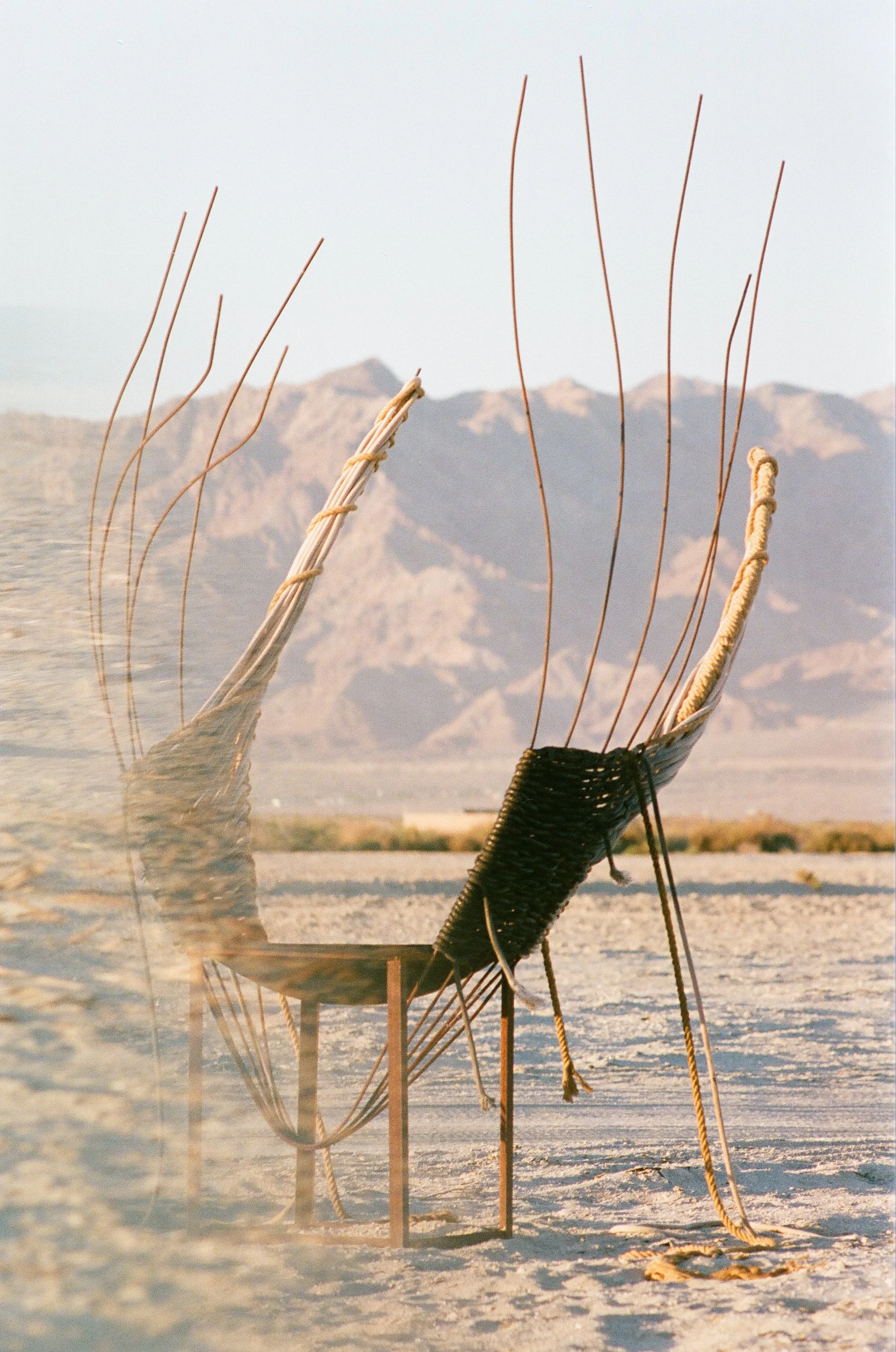
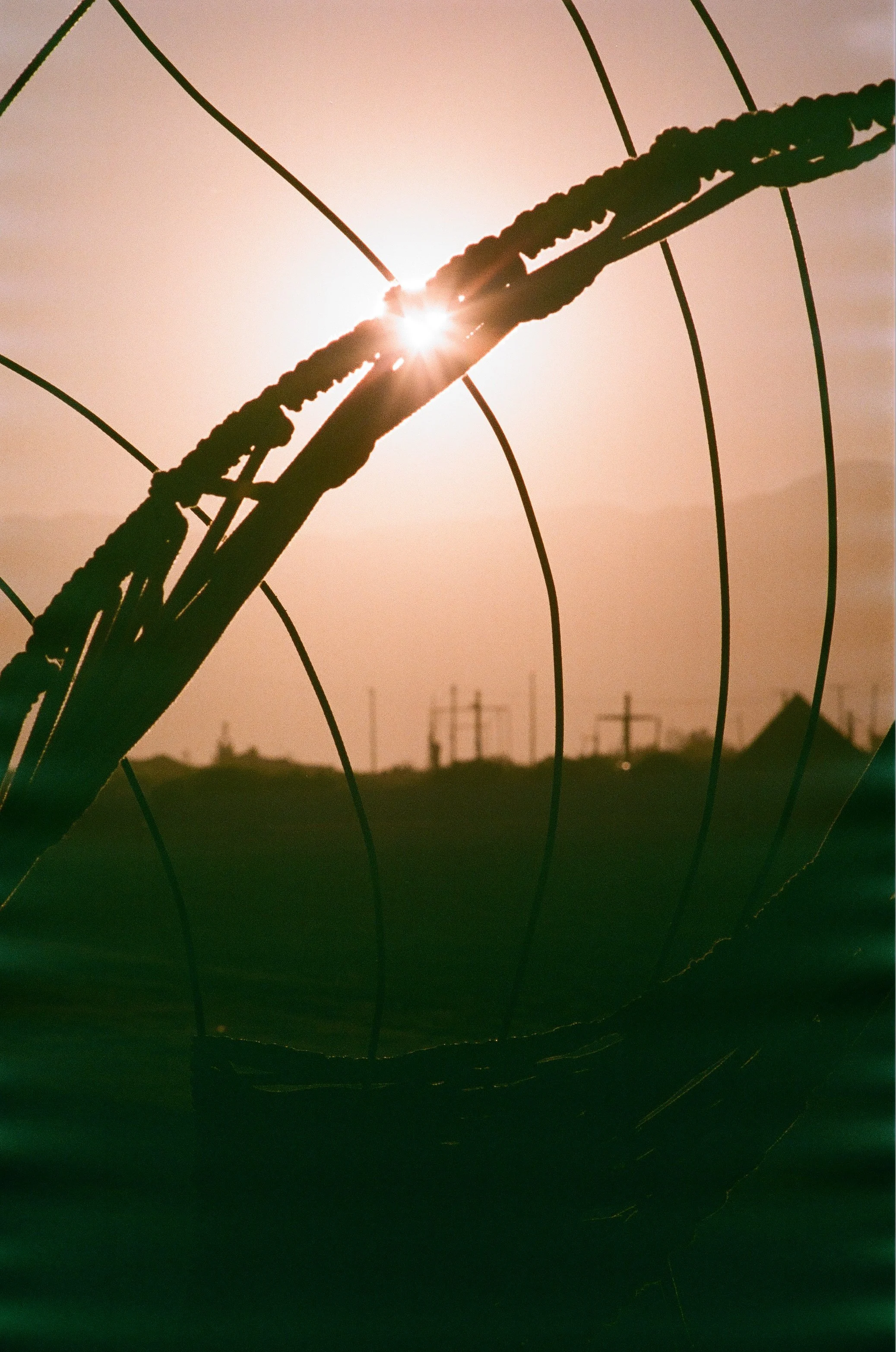
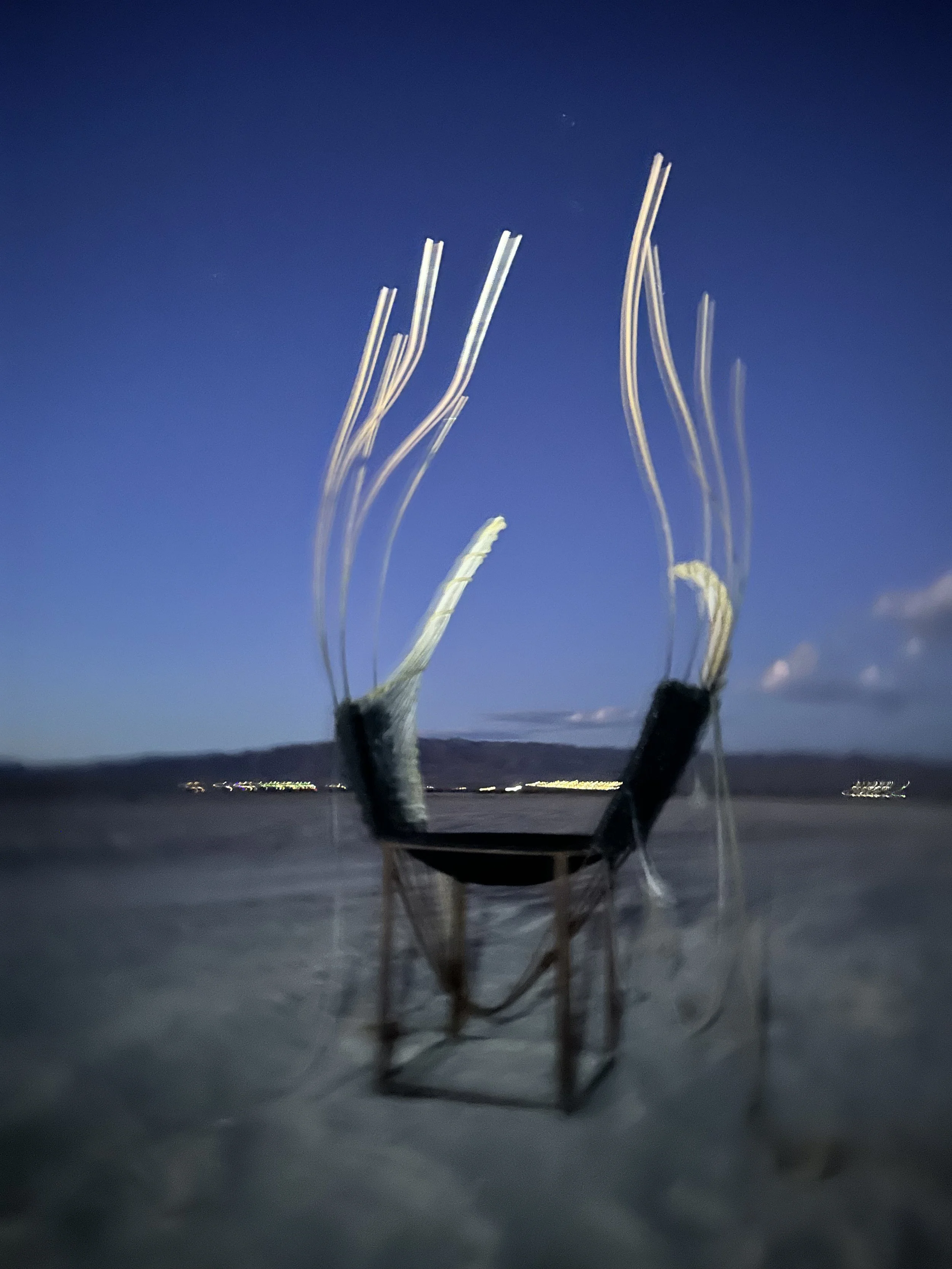
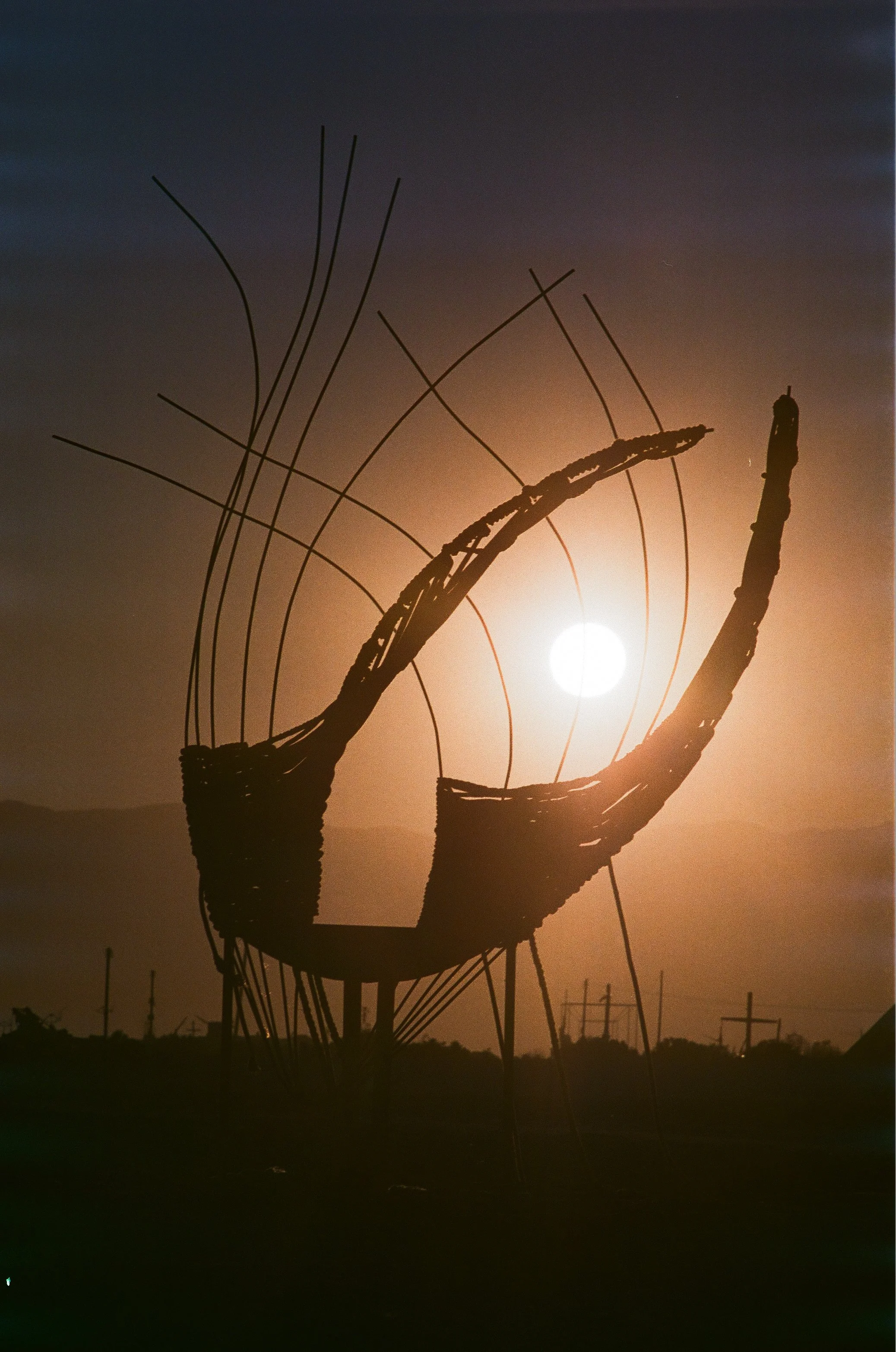
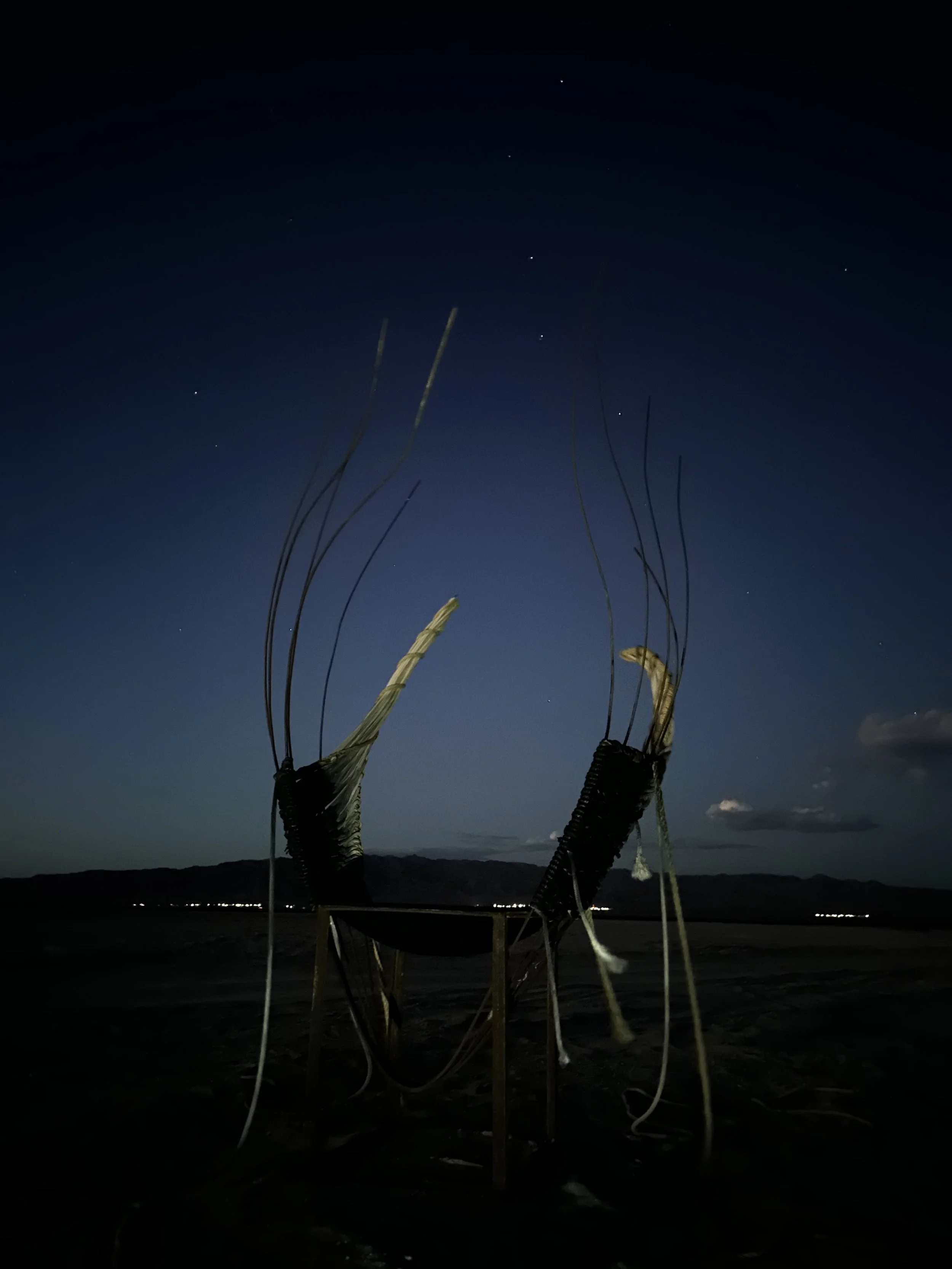
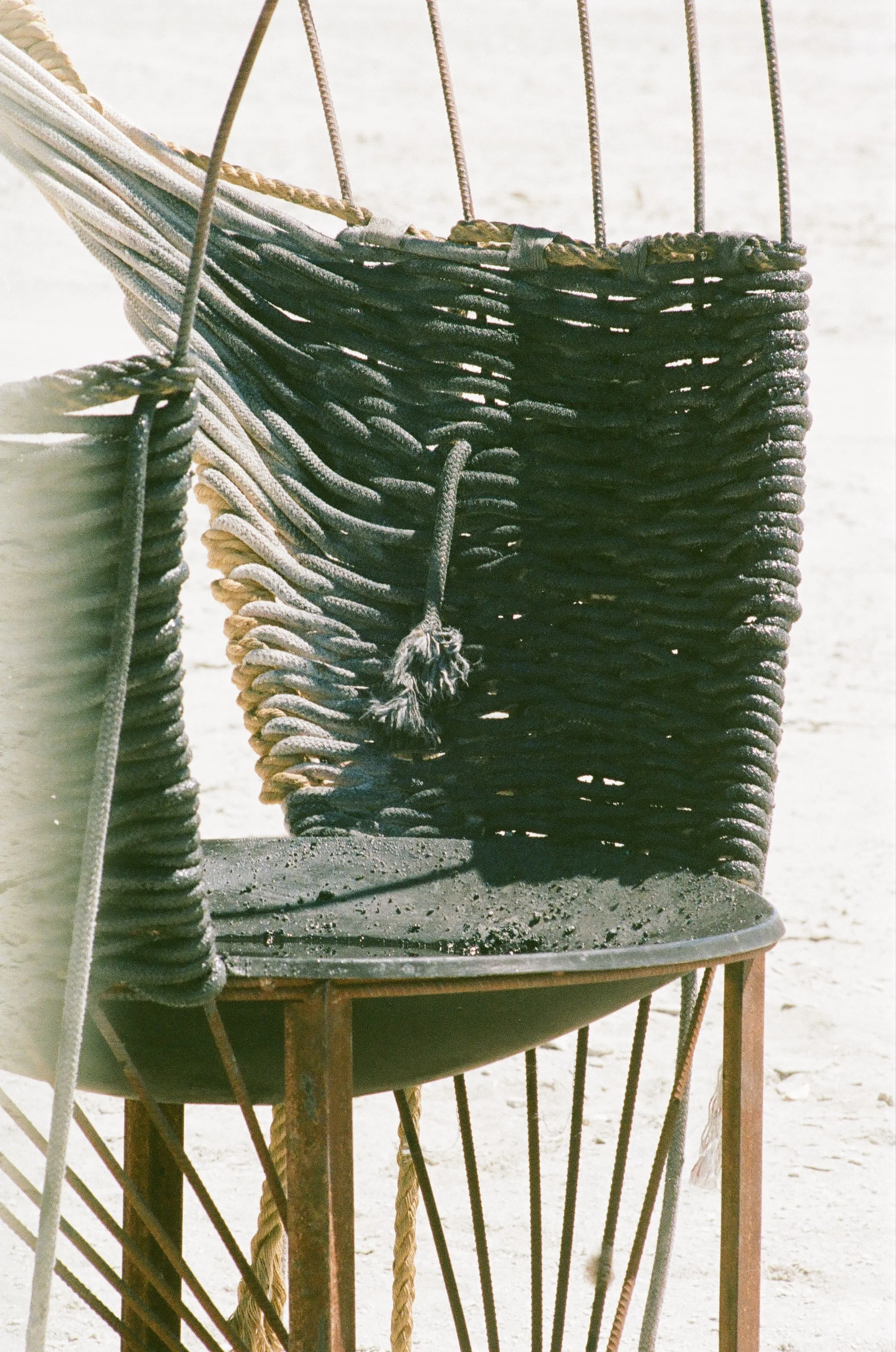
Aperion
~ boundlessness
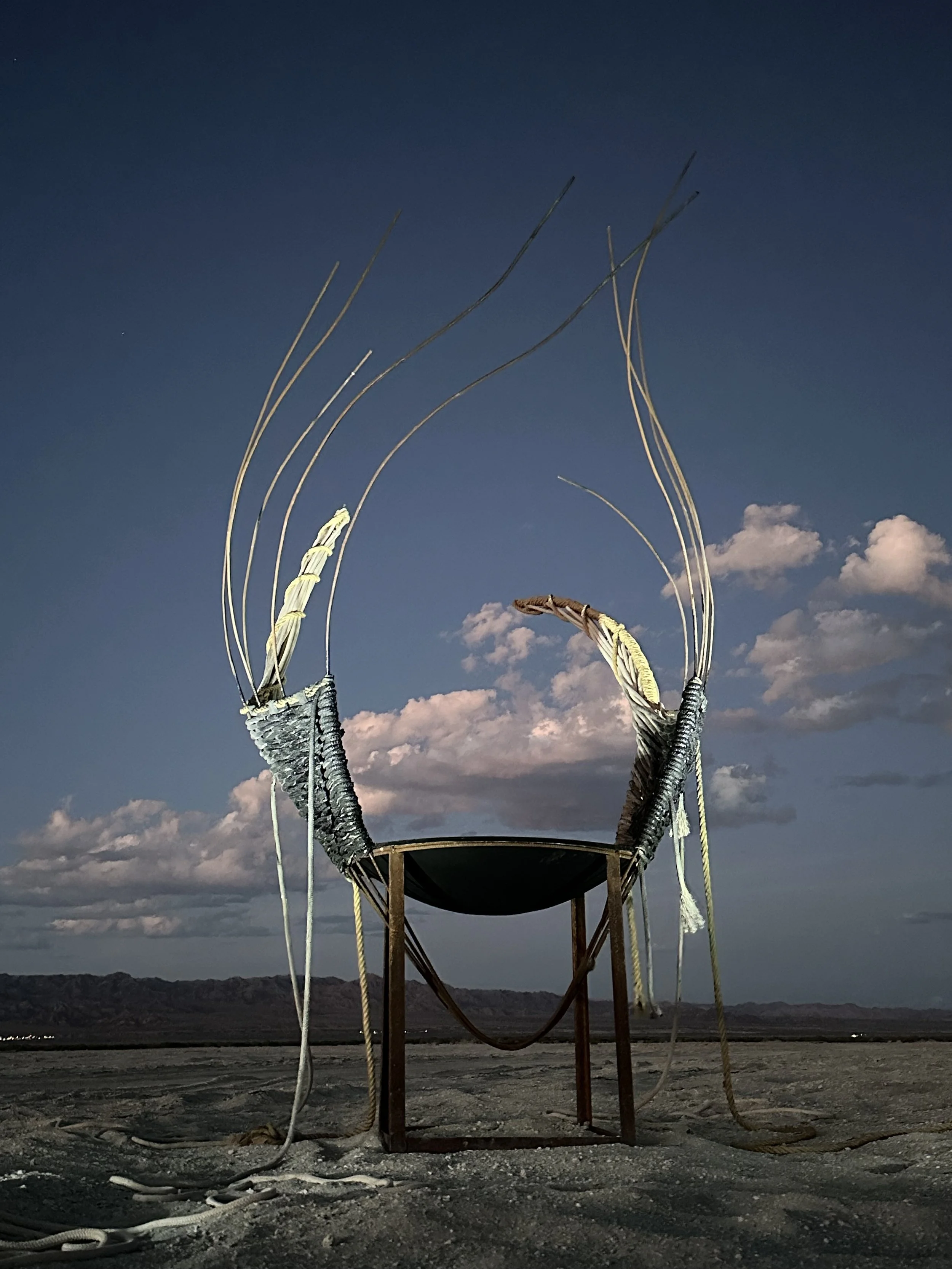
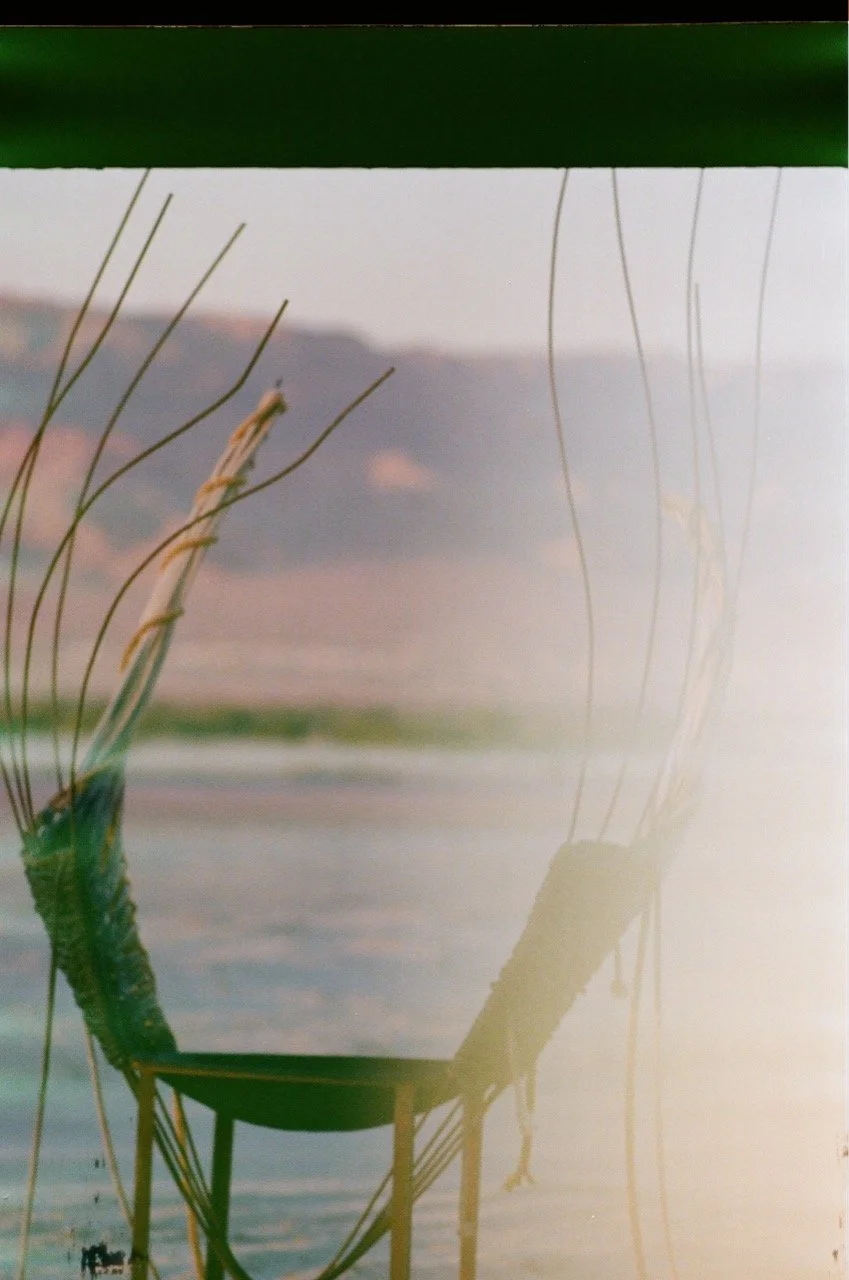
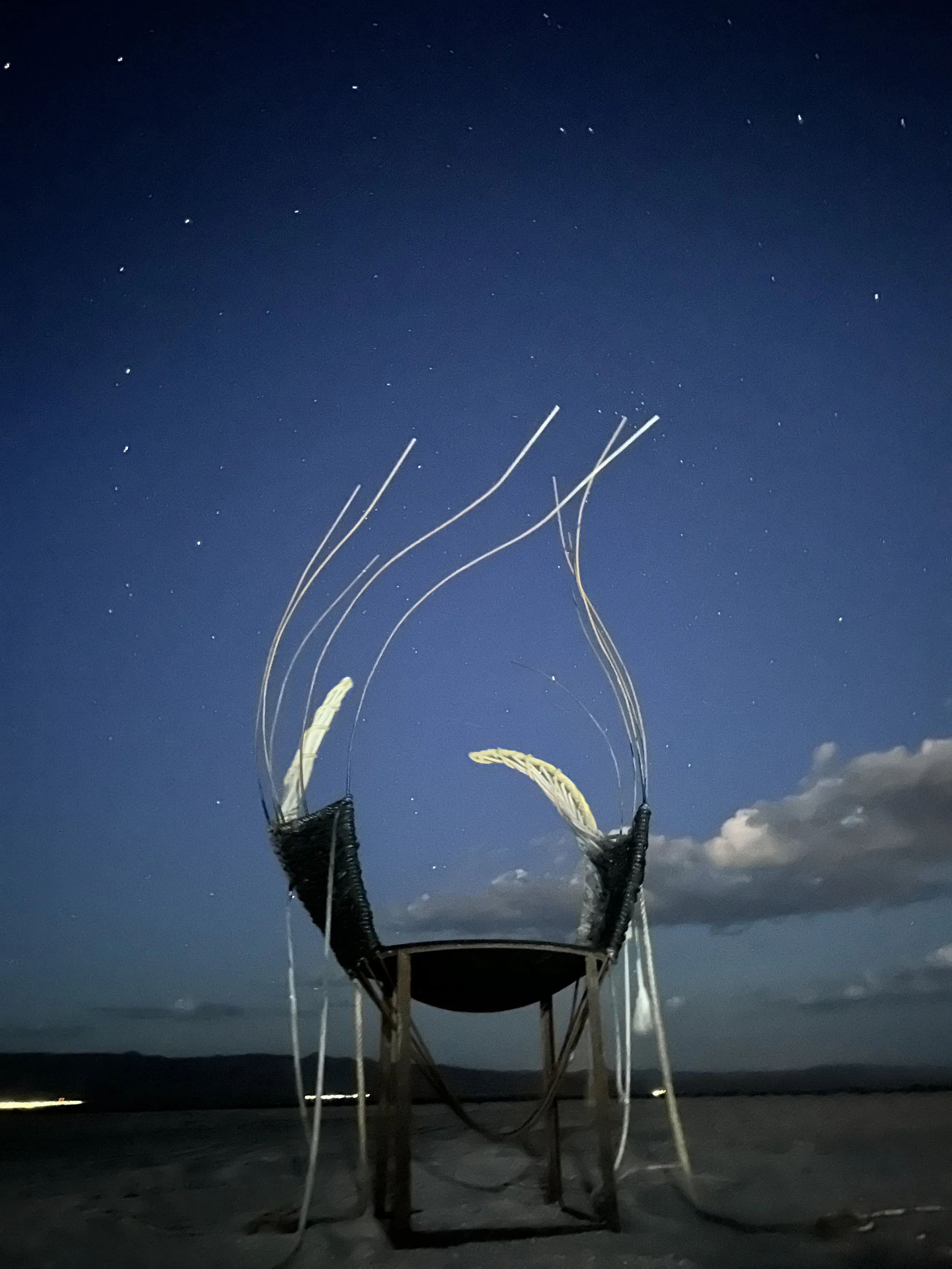
Rope, steel, resin, charcoal from scorched wetlands, Colorado River water.
Salton Sea, 2026
Apeiron (/əˈpaɪˌrɒn/;[1] ἄπειρον) is a Greek word meaning '(that which is) unlimited; boundless; infinite; indefinite'[2] from ἀ- a-'without' and πεῖραρ peirar 'end, limit; boundary',[3] the Ionic Greek form of πέρας peras 'end, limit, boundary'.[4]
The unbounded edge of the real; a wild beyond-human intelligence dancing in the wind, 4 billion years in the making.
The river Lethe was the aqueous threshold to the unknown, the river of oblivion facilitating the shedding of all memory and attachments. In that darkness lie the depths of all things- we are born from a womb that lets just as much light pass through the swollen belly of the mother as that of a full moon. Wedded to night. Birthed from and returning to it. What would we know if we lent into unknowing? What do we need to forget to remember? Aperion is the unknown looking back at you.
Forget what you think you know. Listen to what you cannot understand. Collaborate with the incomprehensible. In learning, the unknown is always our greatest ally. We are all flying at night.
The Salton Sea is a sentinel ecosystem undergoing ecological collapse; an ever diminishing 320 mi.² of water pooling in a below sea level sink at the lowest point of the Colorado River’s historic watershed. Liminal, vulnerable and highly responsive – the sea speaks a truth of the human relationship to nature that is profoundly difficult to accept. Climate change is accelerating its demise.
In the Imperial Valley where the sea condenses, the industry of agriculture works water into a green quickening. Crop cycles shortened, new shoots forced out of season by the unending sunshine and "rain for rent" irrigation. Geothermal plants send out a deep churning hum, steam plumes. Everywhere in the valley, value is being extracted from water. What could be left in the wake of this, but ghost water? Invisible yet present, an echoing dream of what once was; a shimmering sea of blue in the desert, too beautiful and vulnerable to survive in our time of ecological brutality.
Aperion came to be on the shores of this disaster. My own personal loss of my mother to cancer, mirroring the loss of a place that I love. What is it to love something that is dying in front of you? I returned to the Salton Sea in the wake of grief, bound to an other world – a tuning fork set to somewhere beyond the living now; to a place where things reside that cannot any longer be reached. I turned my attention to the fire and made a pigment black as the desert night. Charcoal collected from ashen piles, the remains of burning wetlands at the sea’s south shore, hammered and ground into a fine stellar dust; I rebuilt a heart in these colours.
Weaving taught me a new patience, something of manual dexterity and the impossibility of cutting corners. You cannot cheat at weaving, and unweaving to correct mistakes becomes as much of a practice for a novice weaver as weaving onwards, balanced always on the edge of becoming and undoing. The work I make is always in relationship to my own body; the limits of my arm’s span, the maximum weight I can carry, the grip strength of my hands, this piece is no different. Each work entrains my body to a new practice, builds strengths and capacities – extending my being into the material world.
When the Colorado River breached the banks of a new canal designed to irrigate the imperial Valley at the turn of the century, creating the Salton Sea, river water flooded into the valley at a rate of 75,000 cubic feet of water per second, raising a body of water over 400 mi.² by 7 inches per day. A rebellion of water.
Years were spent trying to stem the flow before it was successfully abated. In a very early photograph from that time, individuals from the Native American tribe local to the area stand waist deep in flowing water weaving reed mats, brought in by the engineering team to put their knowledge to the problem; weaving in submersion, but nets cannot hold water. The indigenous technologies could not reverse the weight of imbalance introduced by modern machinery, however the image is striking, the subtlety and locality of the approach feels sensitive, beautiful and overwhelmingly commensurate with the ecology around it. A material language born of a conversation moving in both directions.
The sea now is unquestionably dying, along with the forms of life its waters supported. Whether dying is a human concept or not, dying has been linked to living for 4 billion years of evolution for life on Earth. Humans and their enterprises are enacting a new form of death upon the fabric of life on this planet. Current extinction rates are estimated at 1000 to 10,000 times that of the fossil record (barring catastrophic extinction events); this form of death is not the cycling life-death-life of call and response in evolution that has insured the continuity of life on Earth. This uncoupling of death from life is a new kind of finitude, an irreversible loss of ecological intelligence, millions, in some case billions of years in the making. The loss is truly incalculable, for what we are losing we do not know.
Here the wind speaks the truth of the land, carrying dust from the exposed lake bed through the air, articulating a history of this place and locating it inside the lungs of human and other animal bodies. Matter is transgressive, it refuses to be contained – something always leaks out. Revelation occurs in the in-between. Years of draining pollutants into the sea made visible in billowing clouds; the truth of our relationship to our environment, spoken back to us, breathed into our lungs.
Aperion calls upon these material extensions to draw awareness beyond the known and into spaces of newness. Wings carries lines of flight for consciousness, synthetic and tensional pathways probing darkness, tethering us to the fertile night of unknowing. Charcoal glistens, a web registers the vibration of tectonic plates shifting beneath it. Sites of extreme sensitivity are our most precious resources for receiving information that we would otherwise miss. Balanced between becoming and undoing; fragility becomes receptivity. Like the environment that birthed it, Aperion is in a state of flux.
The excess of the real pours in through our narrow channels of perception, we exist in the overflow. As the Salton Sea’s waters recede, what is being revealed? The sea is an early warning system of wider ecological health, it is no longer early. We are late in the day and attention to restoring and “saving” this place through human enterprise is blinding us to the greater truth of the message it holds. The intricacy and intelligence of the biosphere will not be replicated by human designed and managed systems, we are losing a delicacy and depth of complexity and connection that we cannot fully comprehend, nor ever get back. I hope my work pulls us towards this awareness, to registering it in our hearts and bodies. Towards humility in the face of this power, and towards a love for its beauty. Given time, the same river that filled the Salton Sea, cut the Grand Canyon.